
Guides
A Guide to Staying on Palm Jumeirah
Trunk, frond or crescent — the three answers to the same question, and why the part of the island you book matters more than the brand above the door.
By The Editorial Team
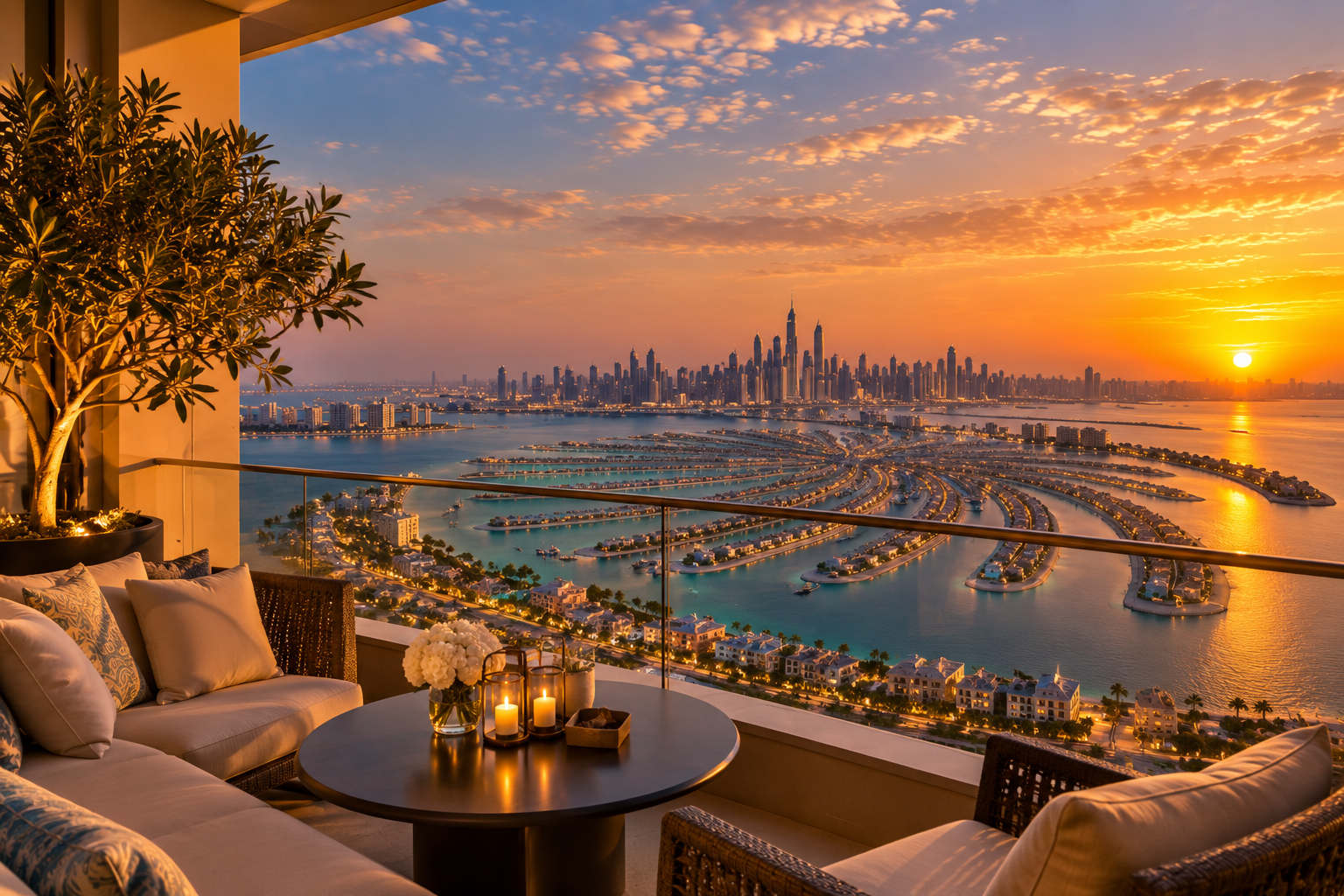
AI-generated image for illustrative purposes.
An island that behaves like a district
Palm Jumeirah is a reclaimed island developed by Nakheel off Dubai's western coast, and it is now a fully inhabited part of the city rather than a resort enclave: residential towers, villas, schools, clinics, supermarkets and a monorail, with the hotels distributed around the edges. Understanding that it is a neighbourhood as well as a destination changes how you read the hotel map.
The practical effect is that 'staying on the Palm' describes at least three quite different holidays. One is a large-resort beach holiday on the outer crescent. One is a small-property, low-rise stay at the tip of a frond. One is an apartment-style or urban-hotel stay on the trunk, close to shops and the monorail, without a private beach. Guests who end up disappointed are usually the ones who booked one and expected another.
This guide sets out how the island is arranged, what each part gives you, how long the internal journeys really take, and which of the verified luxury properties suits which traveller. Where a detail could reasonably have changed — hours, prices, operating status, restaurant concepts — we say so rather than committing to a number.
The anatomy: trunk, fronds, crescent
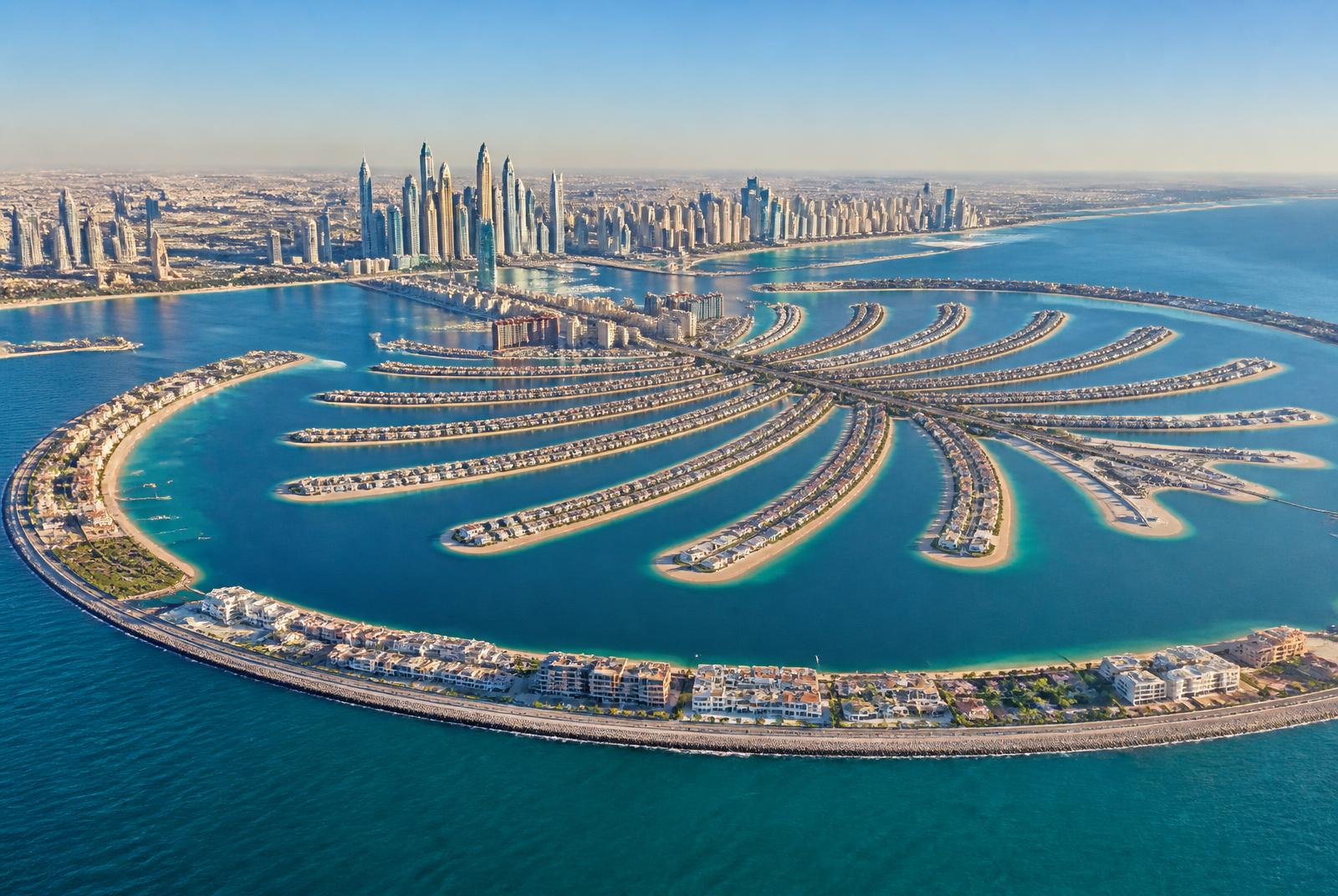
The trunk is the stem connecting the island to the mainland. It carries the main road spine and the monorail, and it is where the island's everyday life happens: apartment buildings, a mall, clinics, the public beachfront on the western edge. Hotels on the trunk are urban in feel and rarely have wide private beaches.
The fronds are the residential branches — sixteen of them, lined with villas and largely private. A small number of hotels sit at frond tips, and those are the quietest hotel positions on the island, reached by a long single approach with no passing traffic.
The crescent is the outer breakwater, a long curved barrier island separated from the fronds by water. Most of the large resorts sit here, facing either inward across the lagoon towards the skyline or outward to the open Gulf. It is the classic Palm position and the one most visitors picture.
Why orientation decides your days
Beaches on the inner side of the crescent look back across the water at the fronds and the mainland towers. You get calm water, the skyline as a backdrop, and light that softens in the late afternoon. Beaches on the outer side face the open Gulf: more wind, more wave, a clean horizon, and direct sun into the evening.
Neither is better; they are different products. Families with small children usually prefer the sheltered inner water. Swimmers and anyone who wants a sunset over the sea rather than over buildings prefer the outer side. Ask which side a hotel's beach is on before booking, because both are described as 'beachfront'.
The trunk's western edge, Palm West Beach, is the public alternative: an open beachfront strip with independent cafés and clubs behind it, facing the open sea. It is livelier than the resort beaches and requires no room key.
Distances are longer than the map suggests
The island's shape is the problem. Because the crescent is an arc and the trunk is a single spine, journeys between distant points follow long curves rather than straight lines. A hotel that looks a short hop across the water from a restaurant may be a twenty-minute drive from it, and at peak hours the funnel at the base of the trunk adds more.
Plan around this rather than against it. Choose a base, keep most meals within a short radius of it, and treat crossings to the far horn of the crescent as a planned excursion. Two long transfers a day is the point at which a Palm stay starts to feel like commuting.
Taxis and ride-hailing are readily available at the resorts. Hotel shuttles exist at several properties and are worth asking about at booking. The monorail runs along the trunk and serves the mall and the Atlantis end; check the operator's current hours and station list, because the service has changed shape more than once.
The large resorts: Atlantis The Royal and Atlantis, The Palm
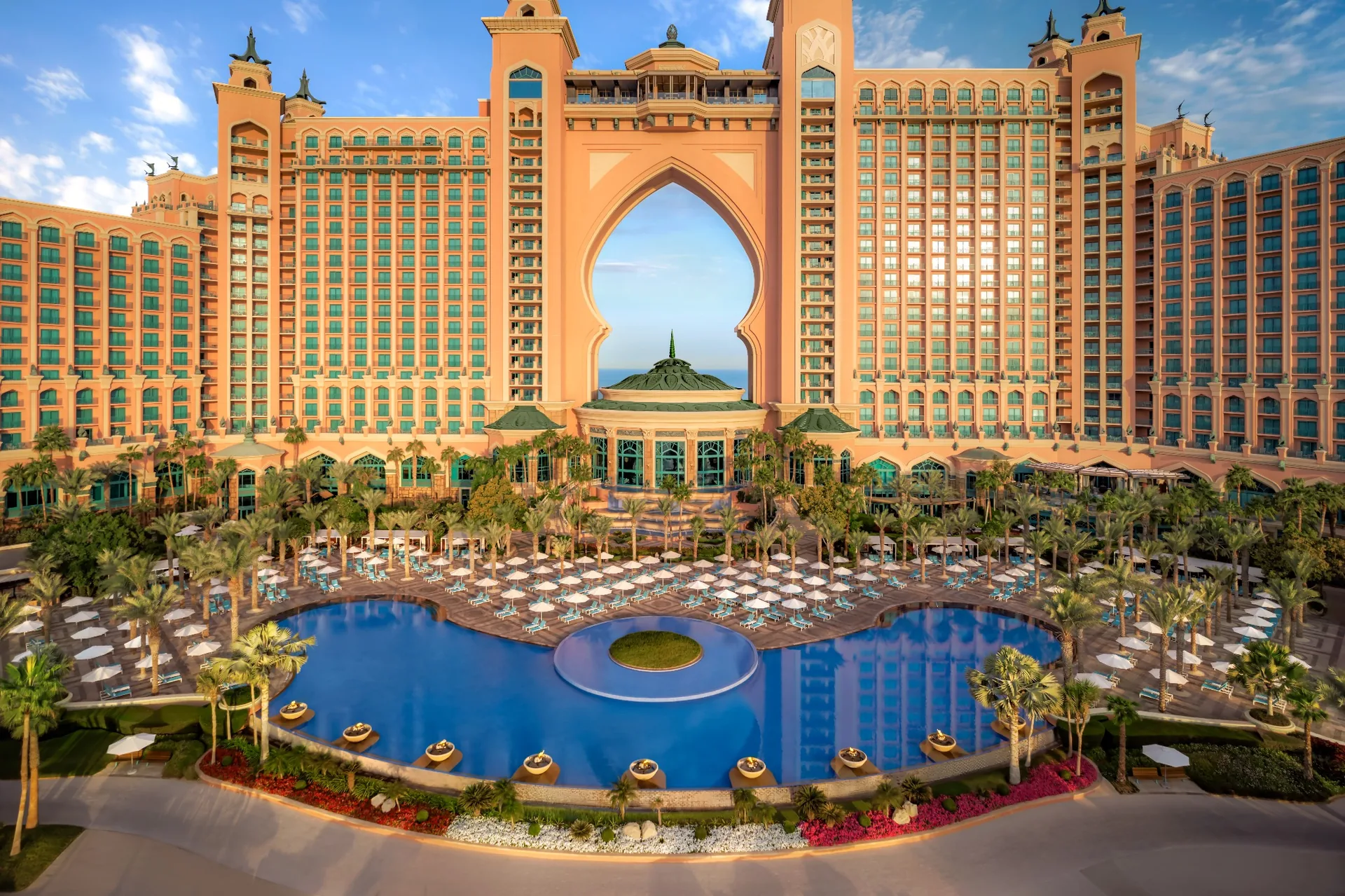
Atlantis, The Palm anchors the top of the crescent and is the island's original resort landmark. Its case is straightforward and strong: the water park and the aquarium attractions are on site, the scale is large enough that a family can spend two or three days without leaving, and the dining spread runs from casual to serious. Couples looking for quiet should treat that same description as a warning.
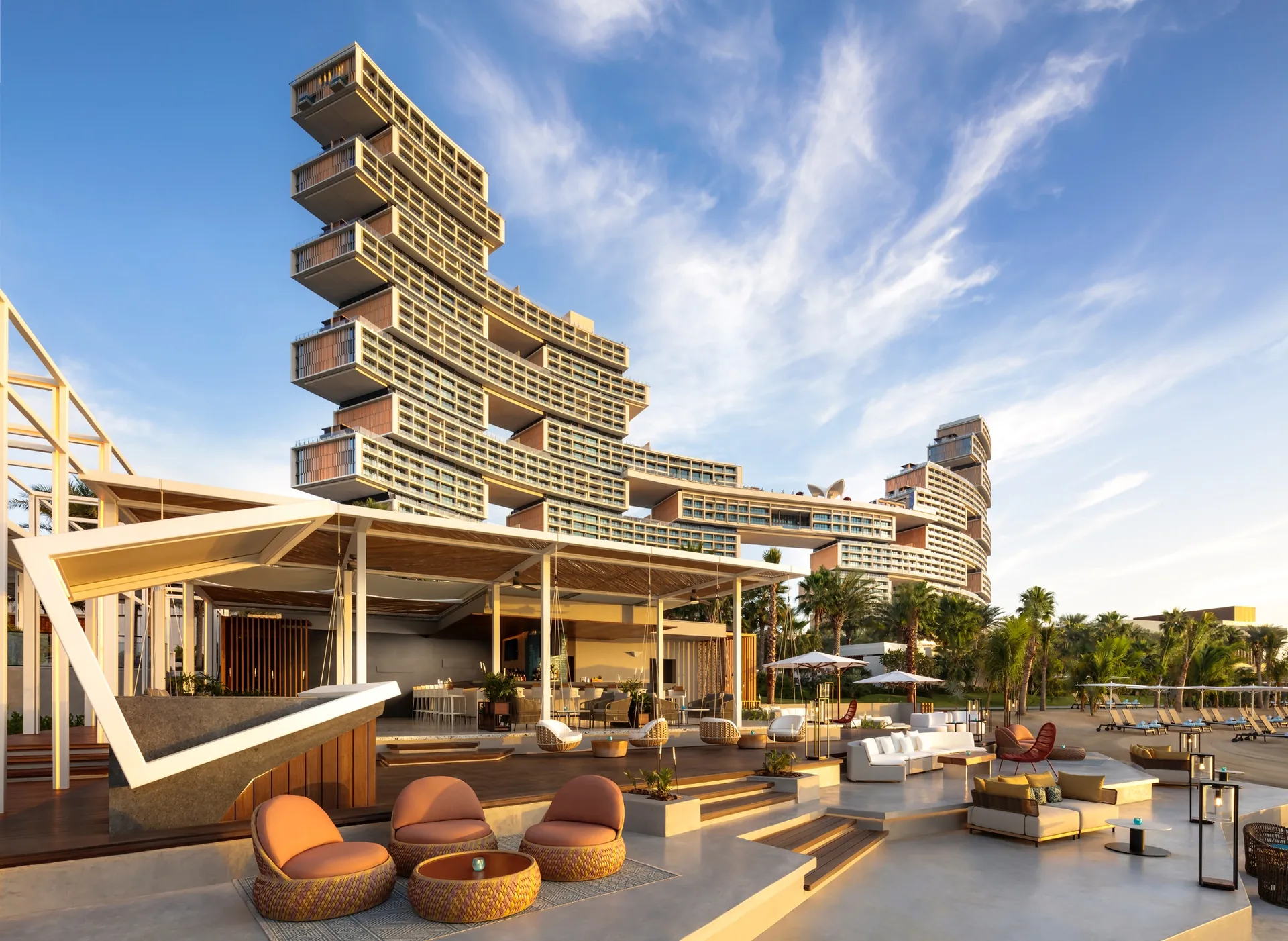
Atlantis The Royal, opened alongside it as a separate hotel, is the more architecturally ambitious of the two — an assembly of stacked, offset volumes rather than a symmetrical arch, with a design-led dining and pool programme. It targets travellers who want the newest and most visually assertive version of the Palm.
The distinction that matters when booking: the older property is organised around attractions, the newer one around design and dining. Guests at either can generally access parts of the other's facilities, but arrangements and charges change — confirm with the hotel rather than assuming.
The quiet end: One&Only The Palm
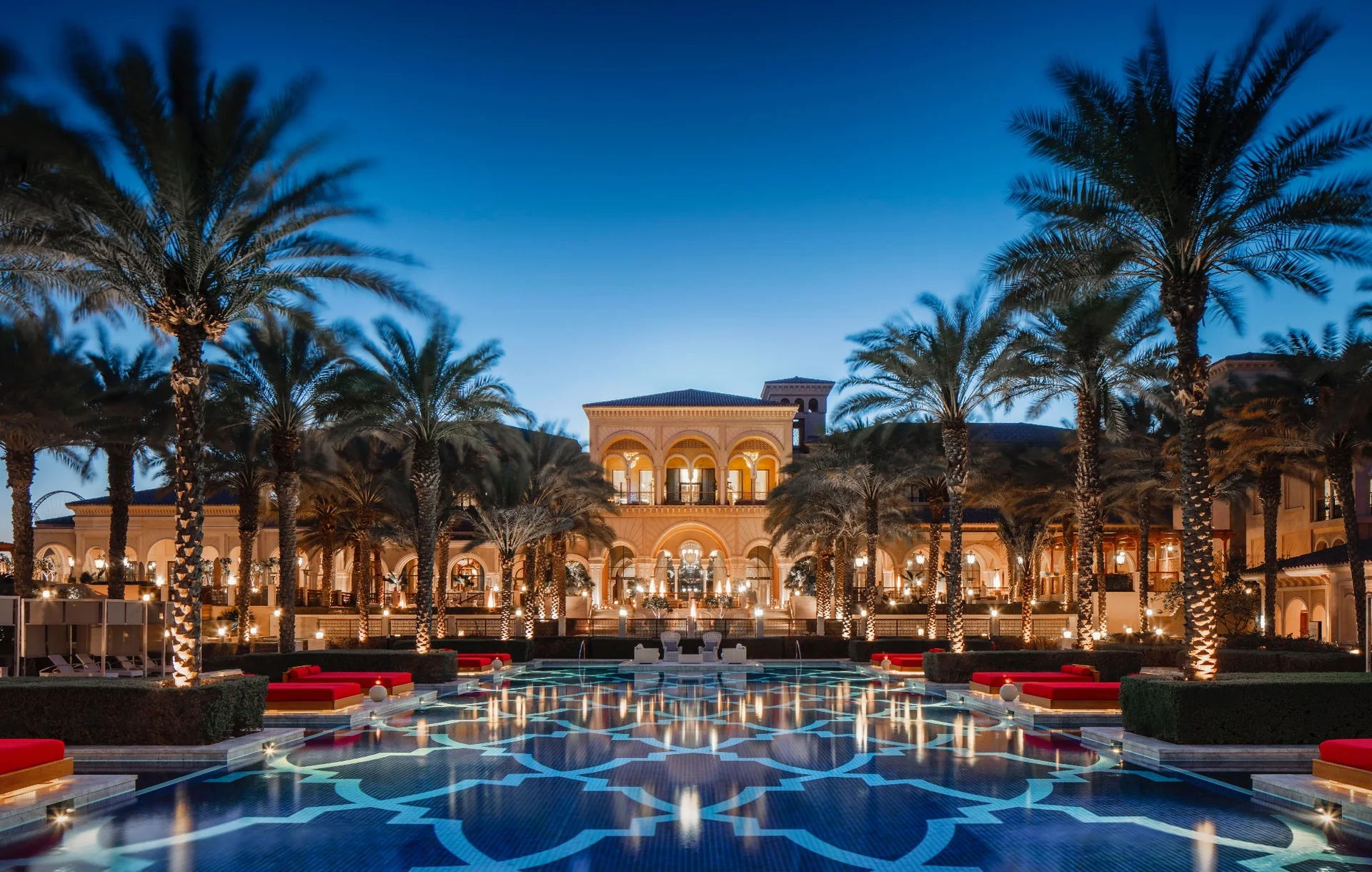
One&Only The Palm occupies the western tip of a frond, reached by its own approach road, and is deliberately small by Palm standards. The architecture is low-rise and Andalusian-influenced, the grounds are enclosed, and the property has long positioned its main restaurant as a destination rather than an amenity — though, as everywhere in Dubai, chef affiliations and concepts should be checked on the hotel's current site before you build an evening around one.
It is the strongest choice on the island for couples, for longer stays, and for travellers who would rather have privacy than a water park. It is the weakest choice for families who need constant activity on site, and for anyone who wants to walk out into somewhere with life on the street — there is none, by design.
The resort classic: Anantara The Palm Dubai Resort
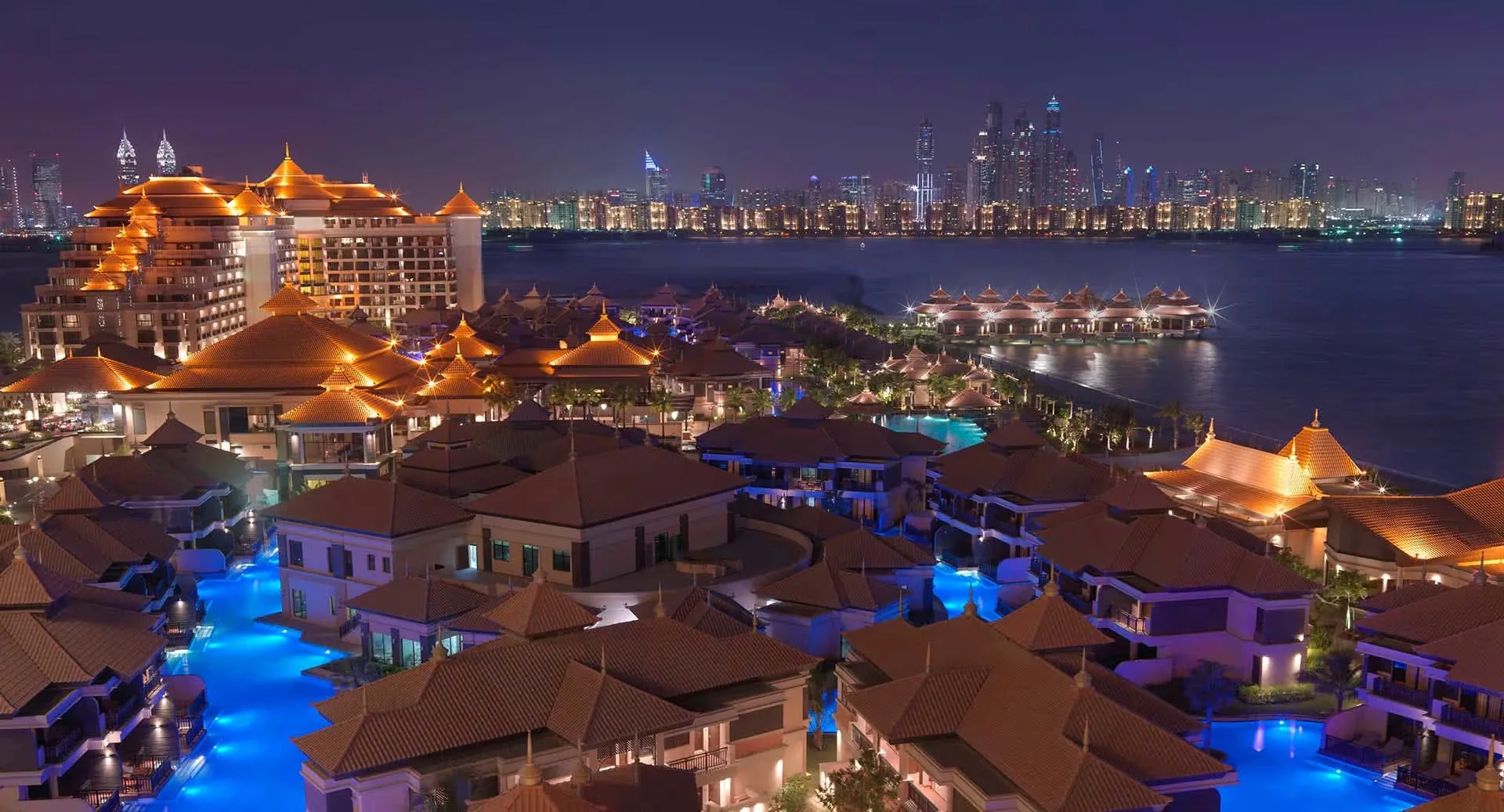
Anantara sits on the eastern crescent and offers the island's most conventional resort format: low buildings around lagoon pools, over-water villa accommodation, and a spa programme drawn from the group's Thai heritage sitting close to the centre of the offer.
It suits travellers who want a beach holiday that happens to be in Dubai, rather than a Dubai trip with beach time attached. Guests who intend to spend most of their days in the city will find the location works against them; guests who intend to spend most of their days on a lounger will find it works entirely in their favour.
Choosing between them
Families with children under twelve: the attraction-anchored end of the crescent, where the water park removes the daily question of what to do.
Couples on a short, design-conscious trip: the newer of the two Atlantis properties, or the frond-tip resort if quiet outranks spectacle.
Longer stays and honeymoons: the frond, without much hesitation. Privacy compounds over a week in a way that facilities do not.
Spa-led or rest-led trips: the eastern crescent resort format, where the pace is slower and the spa is central rather than an add-on.
Travellers splitting their time with the city: reconsider the Palm entirely. Downtown or DIFC will serve you better, with an afternoon on the island rather than a base on it.
Beyond the hotels: what the island itself offers
Three ticketed attractions justify leaving a property: the water park, the aquarium and the observation deck on the trunk, which is the only place that shows you the shape of the island properly. All publish current pricing and timed-entry rules on their own sites, and sunset slots at the deck are the ones that disappear first.
Free of charge, there is the Palm Jumeirah Boardwalk along the outer crescent — the promenade that Visit Dubai lists among the island's public spaces — and the public beachfront on the trunk's western side. Both are best early or after dark.
The mall on the trunk exists mainly as air-conditioned refuge and everyday shopping. It is not a reason to visit the island, but it is useful at two in the afternoon in July.
Seasonality and what it does to prices
Rates on the Palm track the weather more sharply than in the city districts, because the product here is outdoors. The cool months are the expensive months; summer discounts are real and so is the reason for them. Sea temperature climbs with air temperature, and by midsummer the water is warm enough that it stops cooling you down.
Check the National Center of Meteorology's forecasts close to travel rather than relying on seasonal averages, and check Visit Dubai's current Ramadan guidance if your dates fall in that period — it changes the daytime rhythm of dining and entertainment, which is worth knowing in advance rather than discovering on arrival.
The Dubai Hotels Magazine view
The Palm is at its best when it is the whole point of the trip. Booked as a base for exploring Dubai, it costs you an hour a day and delivers less than a central address; booked as a destination in itself, it gives you something the mainland cannot — a resort holiday with a world-famous skyline as the view rather than the setting.
Choose the part of the island first and the brand second. Crescent for beach width and scale, frond for privacy, trunk for convenience and price. The rest is a matter of which trade-off you would rather make.
Sources
Factual detail in this article was checked against first-party and authoritative sources on . Times, prices, opening hours and menus change — confirm current details with the provider before travelling.
- https://www.nakheel.com/en/developments/nakheel-collections/palmjumeirah
- https://www.palmmonorail.com/stations
- https://www.theviewpalm.ae/en/about-the-view
- https://www.visitdubai.com/en/places-to-visit/palm-jumeirah-boardwalk
- https://www.westbeach.ae/en/west-beach
- https://www.atlantis.com/dubai
- https://www.oneandonlyresorts.com/the-palm
- https://www.anantara.com/en/palm-dubai
- https://www.ncm.gov.ae/
About the author
The Editorial Team — Reporting, reviews and guides produced by the Dubai Hotels Magazine editorial team.
Our authorsHotels in this article
Where to stay
Palm JumeirahLuxury
Atlantis The Royal
Kerzner's stacked-block landmark on the Palm crescent, built around a chef-driven restaurant collection and a resort programme of its own.
- Beach
- Fine Dining
- Pool
Palm JumeirahResort
Atlantis, The Palm
The original Palm Jumeirah landmark: a kilometre of private beach, Aquaventure Waterpark and The Lost Chambers Aquarium on one estate.
- Beach
- Family
- Pool
Palm JumeirahLuxury
One&Only The Palm
Low-rise Andalusian-inflected rooms, suites and villas on a quiet stretch of the Palm, with two-Michelin-starred STAY by Yannick Alléno.
- Beach
- Fine Dining
- Spa
Palm JumeirahResort
Anantara The Palm Dubai Resort
400 metres of private shoreline, three 24-hour swimming lagoons with direct room access, and the first over-water villas built in the UAE.
- Beach
- Pool
- Spa
Destinations
Explore the destinations
Read next
More from the magazine
GuidesWeekend Guides
48 Hours on Palm Jumeirah
Two days on the island, planned around heat, light and the awkward geography of a place shaped like a tree. Where to begin, when to move, and what a weekend here is actually for.
By The Editorial Team
ExperienceBeach Clubs
Dubai Beach Clubs: What Travellers Should Know
Minimum spends, sun angles, wind, season and the family policies nobody publishes. A practical guide to a category that ranges from excellent to expensively disappointing.
By The Editorial Team
StayHotels
Where to Stay on the Jumeirah Coast
The original luxury shoreline, and still the best compromise in the city between beach and access. How the coast is arranged and which stretch of it suits which traveller.
By The Editorial Team