
Eat & Drink
Rooftop Dining and Drinks in Dubai
A city with this much vertical ambition was always going to put its tables in the air. What actually separates a good Dubai rooftop from an expensive one.
By The Editorial Team
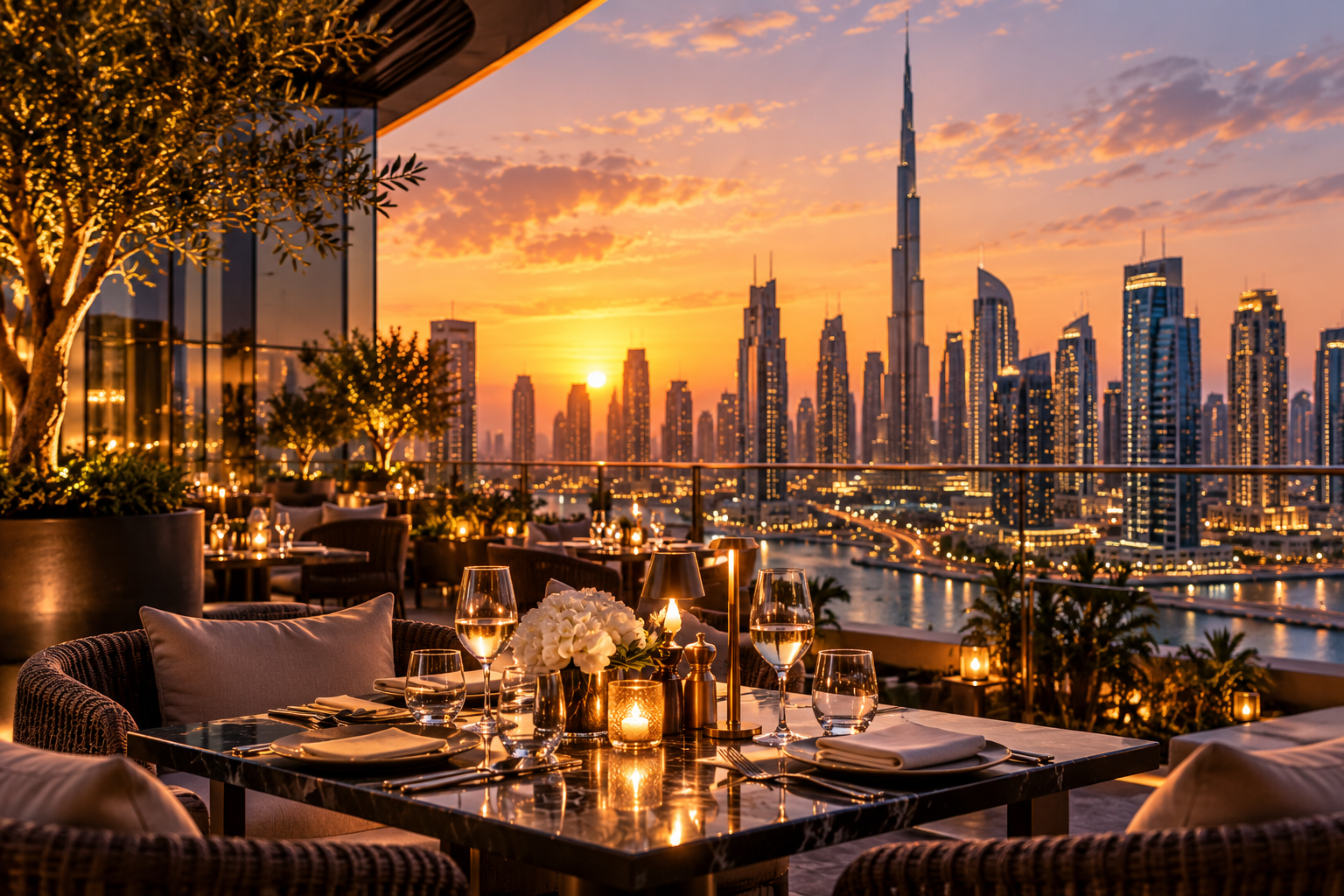
AI-generated image for illustrative purposes.
The category, and its problem
Dubai has more rooftop venues than almost any comparable city, for the obvious reason that it has more roofs worth standing on. The category is also the one where visitors most often overpay for the least, because altitude is easy to sell and difficult to assess from a photograph.
The useful questions are not about height. They are: what does the terrace face, is it usable at the time of year you are visiting, and is the kitchen doing anything the view is not already doing? A venue that answers all three well is rare enough to plan an evening around.
What follows is how to read the category, arranged by what actually varies: season, orientation, format and district.
Season decides everything
From roughly November to March, Dubai's rooftops are among the most pleasant places to sit anywhere. From roughly June to September, an outdoor table at eight in the evening is a test of endurance, and many terraces reduce hours, deploy heavy cooling or close entirely.
The shoulder months are the ones to watch. In April, May and October, the difference between a comfortable evening and an uncomfortable one can come down to which side of a building you are on and whether the venue has misting or shade in the right place. Ask when you book; the reservations team will tell you honestly, because an unhappy guest on a hot terrace is their problem too.
Humidity matters more than temperature near the coast. An inland rooftop in Downtown or Za'abeel will often be more comfortable at the same reading than a beachfront one.
Orientation, and what you are actually looking at
Three views dominate. Facing the Burj Khalifa from Downtown or Business Bay gives you the city's defining silhouette and, from the right angle, the fountain — which is why those tables cost what they do. Facing the sea from the coastal districts gives you sunset over water, a different and calmer proposition. Facing inland from the coast gives you the skyline at distance, which photographs better than it looks.
The mistake visitors make is booking for altitude rather than aspect. A table forty floors up facing a neighbouring tower is worse than a fourth-floor terrace facing open water, and considerably more expensive.
Ask which direction the terrace faces and where the sun sets relative to it. If a venue cannot answer that, the view is not the reason they are in business.
Downtown: the fountain economy
Downtown's elevated venues trade on one thing, and it is the tower. The format is consistent: a high floor, a terrace pointed at the Burj Khalifa, a bar list priced for the outlook and a kitchen ranging from competent to genuinely good.
Address Sky View is the district's clearest example of the type, with a rooftop restaurant that treats altitude as the premise. At ground level, the terraces along Burj Khalifa Lake and at Souk Al Bahar are the alternative — lower, closer to the water and, for the fountain specifically, arguably better placed.
Book early and be specific about what you want: 'a table on the terrace facing the tower' is a different request from 'a table', and only one of them is what you came for.
DIFC: the urban format
DIFC's elevated venues are less about the panorama and more about the room. This is the district where restaurants behave like restaurants — residents outnumber visitors, the crowd is older and better dressed, and the food is generally the point rather than the accompaniment.
Four Seasons Hotel Dubai International Financial Centre and Waldorf Astoria Dubai International Financial Centre both operate elevated venues within a short walk of the district's core, which makes DIFC the only place in the city where a genuine rooftop bar crawl is physically possible on foot.
Because concepts here change fairly often, check the current venue list on each hotel's site rather than a third-party roundup. Several DIFC rooms have been reconcepted more than once in recent years.
Za'abeel: a new altitude
One Za'abeel added something the category had not had: a horizontal building in the sky. The Link, the sky concourse suspended between the development's two towers, is recognised by Guinness World Records as the world's longest cantilevered building and carries dining venues and a pool at height.
What makes it interesting is not the record. It is that the space is horizontal rather than a single rooftop floor, which produces a promenade at altitude instead of one terrace with one aspect. That is a genuinely different experience from the standard high-floor bar.
Access arrangements, venue line-ups and whether non-residents can visit specific spaces are the sort of details that change; confirm before travelling across the city for it.
Licensing, timing and etiquette
Alcohol service in Dubai is licensed, and licensed venues are concentrated in hotels and specific permitted outlets under the emirate's framework. In practice this is why nearly every rooftop bar worth visiting has a hotel attached to it.
During Ramadan the rhythm shifts, with daytime service and entertainment adjusted; Visit Dubai publishes current guidance each year and it is the source to check if your dates fall in that period.
Two practical notes. Dress codes are enforced at the higher end — smart casual generally means closed shoes and no sportswear, and refusals at the door do happen. And most rooftops price differently before and after sunset, so an early table is often both cheaper and more comfortable.
How to plan a rooftop evening properly
Arrive before sunset rather than for it. The transition — the twenty minutes when the light goes and the towers come on — is the whole event, and arriving mid-way means queuing at the lift while it happens.
Do one venue, not three. Dubai's geography punishes bar-hopping everywhere except DIFC, and a rooftop evening broken up by two taxi rides is mostly taxi rides.
And if the weather is marginal, take the indoor table with the window rather than the outdoor table you booked hopefully. The view is the same and the evening survives.
What separates a good rooftop from an expensive one
Four tests, applied in this order. Does the terrace have shade or cooling that works in the month you are visiting? Is the seating arranged so that more than the front row can see anything? Is the kitchen doing recognisable work, or is the menu a list of things that travel well from an indoor pass? And is the music at a level that permits conversation before ten?
Venues that fail the last two are extremely common and often extremely full, because the view is doing all the work. That is a legitimate business, but it is not an evening — it is a drink with a backdrop, and it should be priced in your mind accordingly.
The venues worth returning to tend to be the ones attached to hotels with a serious food operation elsewhere in the building. A kitchen brigade that has to satisfy a restaurant downstairs rarely allows the terrace upstairs to coast.
Rooftop pools, and the day-to-night format
A significant share of Dubai's elevated venues are pool decks that convert to bars in the evening, and the two experiences are almost unrelated. Daytime is loungers, minimum spends and sun; evening is tables, a different menu and often a different door policy.
If you want the pool, go early and check whether non-residents are admitted at all — many hotel rooftop pools are guest-only in the daytime and open to the public only after a certain hour. If you want the bar, arrive before sunset and do not expect the pool to be available to swim in.
Access rules, hours and whether swimming is permitted at all in the evening change seasonally. This is the single most common source of confusion in the category, and one phone call resolves it.
The Dubai Hotels Magazine view
The rooftop is the most oversold and most rewarding category in Dubai dining, and the difference between those two outcomes is almost entirely planning. Book for aspect and season rather than altitude and name, arrive early, and treat the venue as a place to spend three hours rather than a photograph to collect.
Done well, it is the clearest single argument for why people keep coming back to this city — a table in the air above a skyline that did not exist in living memory.
Sources
Factual detail in this article was checked against first-party and authoritative sources on . Times, prices, opening hours and menus change — confirm current details with the provider before travelling.
- https://www.addresshotels.com/en/hotels/address-sky-view
- https://www.onezaabeel.com/the-link/
- https://www.guinnessworldrecords.com/world-records/617033-longest-cantilevered-building
- https://www.fourseasons.com/dubaidifc/dining/
- https://www.hilton.com/en/hotels/dxbdiwa-waldorf-astoria-dubai-international-financial-centre/dining/
- https://www.dubaidet.gov.ae/en/licences-and-permits/hospitality-services-and-permits
- https://www.visitdubai.com/en/articles/how-to-experience-ramadan-in-dubai
- https://www.ncm.gov.ae/
About the author
The Editorial Team — Reporting, reviews and guides produced by the Dubai Hotels Magazine editorial team.
Our authorsHotels in this article
Where to stay
Downtown DubaiLuxury
Address Sky View
Emaar's twin towers in Downtown Dubai, linked high above the street by a sky bridge, with the Burj Khalifa in the window.
- Pool
- Fine Dining
- Rooftop
Za'abeelLuxury
One&Only One Za'abeel
An all-suite city resort in the One Za'abeel towers, connected by The Link — the cantilevered skybridge over Sheikh Zayed Road.
- Fine Dining
- Spa
- Pool
DIFCLuxury
Four Seasons Hotel Dubai International Financial Centre
Four Seasons' smaller Dubai address, inside DIFC — built for business days and a dining scene that runs late.
- Fine Dining
- Spa
- Pool
DIFCLuxury
Waldorf Astoria Dubai International Financial Centre
Waldorf Astoria's DIFC tower: a business-district address with a dining programme that draws the district in.
- Fine Dining
- Spa
- Pool
Destinations
Explore the destinations
Read next
More from the magazine
AI-generated image for illustrative purposes.
Eat & DrinkHotel Restaurants
Dubai's Hotel Dining Scene
In most cities, hotel restaurants are where you eat when you have run out of ideas. Here they are the idea. How the city's dining ended up inside its hotels, and how to navigate it.
By The Editorial Team
StayWhere To Stay
Where to Stay in Downtown Dubai
The one district where you can leave the car behind. What Downtown actually covers, how the micro-locations differ, and the trade you make by booking here.
By The Editorial Team
StayWhere To Stay
The Business Districts: Staying in DIFC and Business Bay
Two districts built for work that turned into the most convincing places in Dubai to eat, drink and — increasingly — stay. Why leisure travellers keep booking them by accident and staying on purpose.
By The Editorial Team